

If your jaw clicks, aches, or feels tight when you chew, you might be dealing with TMJ disorder, and that can feel confusing and frustrating. The temporomandibular joint is small, but when it hurts, it can affect how you eat, speak, and even sleep. You should not have to wonder why something as basic as chewing suddenly feels uncomfortable in your own body.
At Grand Prairie Family Dental, Dr. Behrooz Khademazad has spent 34 years helping patients in Grand Prairie understand jaw pain with patience and clarity. His background in orthodontics, restorative dentistry, and cosmetic care allows him to look at the whole picture instead of chasing symptoms. Patients from Westchester, Dalworth Park, Mira Lagos, and Lakewood Grand Prairie often say the biggest relief is finally understanding what is happening and why.
What Is TMJ Disorder?
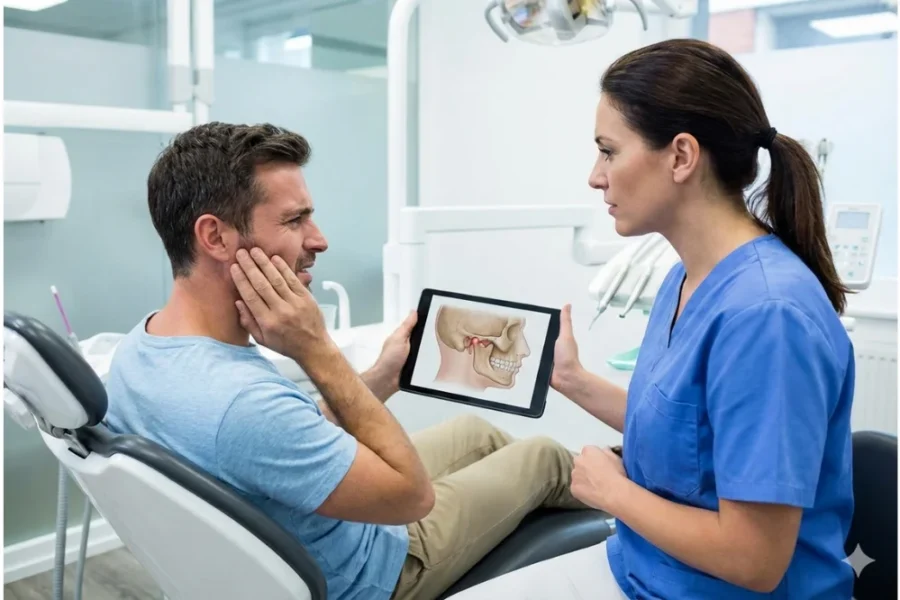
TMJ disorder, also called TMD, refers to a group of conditions that affect the jaw joint and the muscles that control jaw movement. The temporomandibular joint sits just in front of each ear and connects your lower jaw to your skull. It works like a sliding hinge that rotates and glides at the same time, allowing smooth movement in several directions.
When everything works together properly, you do not even notice this joint doing its job. When something disrupts that coordination, whether muscle tension, disc displacement, or inflammation inside the joint, pain and stiffness begin to show up. You might notice jaw soreness, headaches, ear discomfort, or a bite that suddenly feels different.
It also helps to clear up confusion about terminology. TMJ refers to the joint itself, while TMJ disorder describes the conditions affecting that joint and the surrounding muscles. The condition can be mild and occasional, or persistent and disruptive to daily life.
How the TMJ Works (And What Goes Wrong)
The TMJ is small, but it is complex and constantly in use. The rounded end of your lower jaw sits inside a shallow socket in the skull, and between those bones rests a soft disc that cushions movement and absorbs shock. Ligaments hold the joint steady, and strong chewing muscles guide every motion you make.
A healthy TMJ rotates first and then slides forward in a smooth, coordinated pattern. When the disc shifts out of place, the muscles tighten excessively, or the ligaments stretch beyond their comfort zone, that smooth movement becomes uneven. Over time, repeated imbalance can lead to clicking sounds, inflammation, stiffness, and pain that worsens with everyday activities like eating or speaking.
Major Causes of TMJ Disorder
TMJ disorder rarely develops overnight. More often, it builds slowly as small stresses add up over months or even years. Many patients in Mountain Creek Townhouses and Florence Hill describe looking back and realizing the signs were there long before the pain became obvious.
The most common contributing factors include:
- Teeth grinding and clenching
- Bite misalignment or shifting teeth
- Jaw injury from accidents or sports
- Arthritis affecting joint cartilage
- Stress, posture, and daily habits
When several of these factors overlap, the joint can exceed its natural tolerance. A careful evaluation connects your personal history to the strain your joint is experiencing.

Muscle-Related Causes: Grinding, Stress, and Posture
Muscle tension is one of the most common drivers of TMJ disorder, and it often builds quietly over time. Grinding and clenching, known as bruxism, place steady pressure on the jaw joint and the muscles that support it. Many people grind at night without realizing it, while others clench during stressful moments throughout the day, especially during long drives through Grand Prairie or while working at a desk for hours.
Stress and posture can quietly amplify that strain. Forward head posture from phones and computers shifts the balance of the jaw and forces the muscles to work harder than they should. Over time, that constant tension leads to soreness, headaches, and jaw fatigue, even if you cannot pinpoint when it started.
Joint and Structural Causes: Bite, Injury, and Arthritis
Structural issues inside the joint can also contribute to TMJ disorder. When your bite does not meet evenly, the jaw may subtly shift to find comfort, placing uneven pressure on one side of the joint. Missing teeth, worn dental work, or natural shifting over time can alter that balance.
Past injuries matter more than many people realize. Falls, sports impacts, and car accidents can stretch ligaments or disturb the cushioning disc. Even if the injury seemed minor at the time, the joint can respond months or years later.
Arthritis can also affect the TMJ just like other joints in the body. Osteoarthritis gradually wears down cartilage, while inflammatory forms attack joint tissues more directly. As cartilage thins, movement becomes rougher and discomfort becomes more persistent.
Healthy TMJ vs TMJ Disorder
Understanding the difference between a healthy joint and a strained joint can help you decide when it is time to seek care. A healthy TMJ moves smoothly, quietly, and without discomfort during normal use. A stressed joint often produces noise, stiffness, or pain that becomes more noticeable with chewing or speaking.
| Feature | Healthy TMJ | TMJ Disorder |
| Movement | Smooth and silent | Clicking or limited opening |
| Pain | None | Jaw, ear, or headache pain |
| Bite Feel | Even and stable | Feels off or shifts |
| Muscle Tension | Relaxed at rest | Tight or sore muscles |
If your experience resembles the second column, it may be time for evaluation. Early intervention often prevents more complex joint changes and long-term discomfort. The sooner you understand what is stressing your jaw, the easier it is to protect the joint and avoid bigger problems down the road.
When to See a TMJ Dentist in Grand Prairie
Jaw pain that lasts more than a few weeks should not be ignored. Frequent headaches, locking, or difficulty chewing suggest that the joint may be under strain. Grinding and visible tooth wear add important context to the overall picture.
At Grand Prairie Family Dental, Dr. Behrooz Khademazad approaches TMJ disorder with experience built over three decades in this community. You deserve a clear explanation and a steady plan rather than uncertainty. If you live near Cedar Ridge Estates, Sheffield, or Mira Lagos and recognize these signs, scheduling a TMJ evaluation is a practical step toward relief and long-term comfort.
Grand Prairie Family Dental
2475 W Pioneer Pkwy Grand Prairie, Texas, 75051
Google Reviews: See More Reviews From Grand Prairie Family Dental
View information about local places in our community.
Driving Directions to Our Practice
Frequently Asked Questions
What causes TMJ disorder?
TMJ disorder often develops from repeated joint overload caused by grinding, bite imbalance, arthritis, injury, or stress patterns. Why it matters is that understanding your trigger helps prevent ongoing strain and joint damage. Instead of asking only what is wrong, ask which habits or structural issues are stressing your jaw, because identifying the pattern allows conservative treatment such as splints, bite support, and muscle therapy to reduce inflammation and protect the joint.
Can teeth grinding cause TMJ pain?
Yes, bruxism places heavy pressure on the jaw joint and surrounding muscles, which can inflame tissues and create headaches or facial soreness. Why it matters is that many people grind at night without awareness, allowing irritation to continue silently. Instead of asking if grinding exists, ask whether you show signs like worn teeth or morning jaw pain, because custom night guards reduce pressure and protect joint health.
Does arthritis affect the TMJ?
Arthritis can thin cartilage and change the surfaces of the jaw joint, contributing to TMJ disorder and stiffness. Why it matters is that untreated degeneration can alter your bite and increase discomfort over time. Instead of assuming aging alone explains pain, ask how joint protection and coordinated dental and medical care can reduce strain and preserve movement.
Can TMJ disorder go away on its own?
Some mild TMJ disorder cases improve with stress control and habit changes, but persistent pain requires evaluation. Why it matters is that waiting too long can allow inflammation and muscle tension to build. Instead of hoping it disappears, ask what conservative steps you can begin now, because early intervention often prevents long term joint damage.
Related Articles
Related Posts